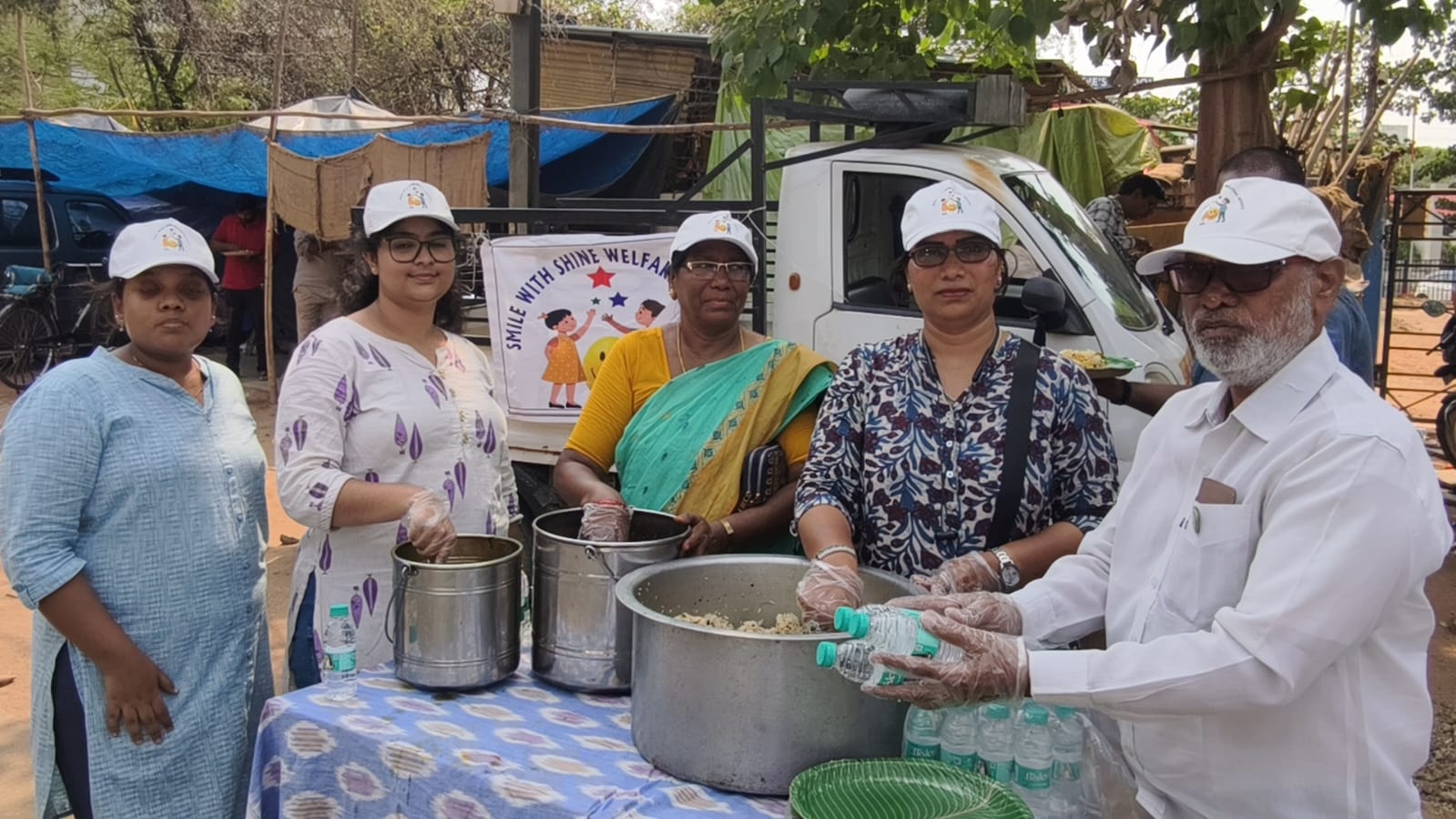
"Compassion, when practiced consistently, has the power to change lives — one Tuesday at a time." — Breakfast Drives, smilewithshinewelfaresociety.org
Most charity calendars are organised around big days. A festival. An anniversary. A donor's birthday. A Christmas drive. Smile With Shine Welfare Society chose a different calendar a long time ago: Tuesdays. Every single one of them. This blog is the unglamorous part — the six lessons we learned along the way about what running a weekly meal drive actually teaches you, and why the day-of-the-week matters more than the cause printed on the poster.
Lesson 1 — The People We Serve Don't Live on Our Schedule
The single most useful sentence to remember when running any kind of hunger relief is this: hunger doesn't take a day off. It doesn't pause for our planning meetings. It doesn't wait for a quarterly campaign. The homeless individual on a Hyderabad pavement is hungry on Wednesday and Thursday too — we just only see him on Tuesday.
That sentence reframes everything. It stops us from being proud of the meals we do serve, and starts us being clear-eyed about the six days we don't. A weekly drive is a fraction of the problem. The honest version of "we feed the homeless" is "we feed the homeless one morning a week, and we wish it was more."
Lesson 2 — Routine Beats Heroics, Every Time
Early on, big one-off events looked attractive. Big numbers, big photographs, big posters. We tried a few. Then we ran a Tuesday a few weeks in a row. The Tuesdays won.
Here's why. A one-off feeds 500 people once. A weekly drive feeds 100 people every week of the year — that's 5,200+ meals annually, served to the same handful of human beings, on the same road, by faces they recognise. The math is closer than it looks. The relationship isn't. There is no equivalent of "I'll see you next week" inside a one-off event.
From our own Breakfast Drives page:
"This is not just a meal drive; it is a weekly reminder that every human being matters, every person deserves to be seen, and that compassion, when practiced consistently, has the power to change lives — one Tuesday at a time."
That word — "consistently" — is doing a lot of work.
Lesson 3 — The Queue Stops Being a Queue
The first Tuesday of a drive on any new road is a queue of strangers. By week four or five, it isn't. The same people show up. Names get learned. Conditions are remembered. Someone's missing this week, and you actually notice. Someone has a swollen ankle, and you actually ask about it next week.
That shift — from queue to community — is the entire point of a weekly cadence. You can't engineer it inside a single event, no matter how big. It requires showing up the same time, the same place, the same way, until the strangers on the road have stopped treating you as a stranger too.
Lesson 4 — Water Is Not a Footnote
We started by focusing on food. We learned to focus on food and water. From the same page:
"Water is also served along with the food to quench thirsts."
On a Hyderabad summer morning, after a night on concrete, the body is dehydrated before it is hungry. The plate matters. The bottle of clean drinking water matters just as much. Skipping the water to save logistics is the kind of optimisation that quietly defeats the whole purpose of the drive. We don't optimise it anymore.
Lesson 5 — Dignity Is Operational, Not Aspirational
It is very easy to claim "we treat everyone with dignity." It is harder to design for it. We learned that dignity, at a roadside drive, is made of very small operational choices:
- Eye contact when handing the plate over. Always.
- Asking "Would you like more?" instead of rationing pre-emptively.
- No queueing logic that punishes the slow. If someone is elderly or unsteady, they don't get pushed to the back.
- No photo extraction. If we don't have consent and a reason, we don't take a picture of someone eating.
- Same volunteers showing up, so the person being served is met by a face, not a stranger in a vest.
None of these are slogans. All of them are decisions that have to be re-made every Tuesday morning at 6 a.m.
Lesson 6 — The Cost Is Smaller Than the Cause Sounds
"Feeding the homeless of Hyderabad" sounds like a multi-lakh problem. In practice, a single Tuesday morning drive for 100+ people is a modest, transparent line item.
| What You Fund | What It Covers |
|---|---|
| One meal | A full, warm meal and drinking water for one person — breakfast or a hot meal. |
| One drive (100+ people) | One full Tuesday morning roadside drive in Hyderabad. |
The full picture is published openly on the Breakfast Drives page because the cause should never feel further away than the receipt.
What the Drive Has Taught Us About Donors
One last lesson, this one about the people who fund the drive rather than receive from it.
The donors who actually change hunger relief in a city are not the ones who write the biggest cheque once. They're the ones who sponsor a Tuesday, every month, for a year. ₹1,000 once a month, for twelve months, funds ten people's meals on twelve consecutive Tuesdays. That is not a small contribution. That is the calendar form of mercy.
If you have been looking for "a meaningful way to help" and the search keeps coming back vague, this is the answer that keeps surviving: pick a day, pick an amount, pick a cadence. Repeat.
How to Sponsor a Tuesday — Step by Step
Step 1 — Pick what you want to fund
- One meal — one warm meal for one person on one Tuesday
- ₹500 — a small handful of meals on one Tuesday (and a tax receipt)
- ₹1,000 — a larger share of meals, ideally every month
- ₹10,000+ — you have sponsored a whole roadside drive
Step 2 — Pay via UPI
GPay / PhonePe to +91 73960 96830 or +91 70937 37459.
Step 3 — Or visit the donate page
For full payment options — QR codes and bank details — visit the donate page.
Tax benefit
"Contributions of ₹500 and above will get a receipt, where you can claim income tax returns." — Donate page
The Bigger Picture
Running a weekly drive is, mostly, an exercise in lowering your idea of "impact" and raising your idea of "consistency." You stop asking how many people you reached today and start asking how many you reached every Tuesday this quarter. You stop chasing the photo and start protecting the route.
That sits inside our broader promise as an organisation: serving humanity with Dignity, Equality & Compassion. The drive is what that promise looks like with a date on it.
Frequently Asked Questions
Because hunger doesn't take a week off. A predictable weekly drive lets the people we serve plan around it, builds trust on the route, and turns a meal into a routine — which is what makes it dignified rather than dramatic. A single large event leaves the gap exactly where it started.
Treating it as a one-way handout. The drive works because it's a relationship — same volunteers, same road, same faces. The moment we tried to scale it like an event instead of a route, the dignity of it started to leak.
One warm meal and drinking water goes to one person — breakfast or a hot meal, depending on the drive. We serve 100+ people every Tuesday, so a whole roadside drive costs roughly ₹10,000+. The full picture is listed openly on our Breakfast Drives page.
How quickly the queue stops being a queue and starts being a community. The same people come back week after week. Names are learned. Stories are remembered. The meal is the excuse — the continuity is the point.
GPay or PhonePe to +91 73960 96830 (or +91 70937 37459), or visit the donate page for full payment options. Contributions of ₹500 and above receive a tax-deductible receipt.
Sponsor This Tuesday's Breakfast
Pick a line item above. Send it. The thing your money names is the thing that happens.
Donate via UPI: GPay / PhonePe → +91 73960 96830
📍 Smile With Shine Welfare Society, Vivekananda Nagar, Mallapur, Nacharam, Secunderabad, Hyderabad — 500076
☎ +91 73960 96830 | +91 70937 37459
Explore More on Our Site
- What Is a Community Learning Centre and Why Does It Matter?
- Donate for Child Education in India: Where Your Money Actually Goes
- The Most Important Meal of the Day: Feeding the Homeless of Hyderabad
- Tuesday Breakfast Drives
- Donate