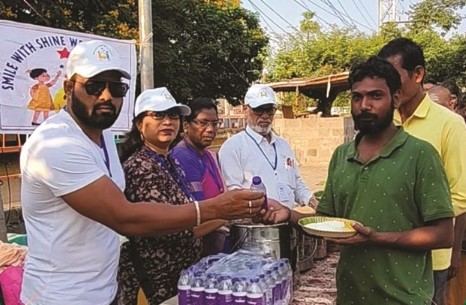
"Homelessness is a circumstance, not an identity." — Interventions, smilewithshinewelfaresociety.org
That sentence sits halfway down our Interventions page, in the middle of a paragraph about Homeless Welfare. It is the single most important thing Smile With Shine Welfare Society has ever written about the people we serve on the streets of Hyderabad. This blog is a note from those streets — about the difference between a label and a person, and why one small grammatical shift quietly rewires the entire idea of welfare.
The Sentence That Anchors Everything Else
From the Interventions page, in full:
"We have connected with many homeless individuals across our communities, providing nutritious meals, warm clothing, and hygiene kits. Every person we reach is treated with the respect and dignity they deserve — because homelessness is a circumstance, not an identity."
That word — because — is doing a lot of work. The respect comes because homelessness is not an identity. Take the second half away and the first half loses its anchor. We don’t treat people with dignity because we’re a good NGO. We treat them with dignity because nobody’s housing status is the most important thing about them. Ever.
What "Circumstance" Actually Means
A circumstance is something you are in. An identity is something you are. The grammar matters. “A homeless person” reads like a class of human being. “A person who is currently without a home” reads like a sentence that has a chapter before it and a chapter after it.
Almost everyone we serve on a Tuesday morning has both of those chapters:
- The migrant who came to Hyderabad for construction work, and lost it when the site shut down.
- The parent who left an abusive household at three in the morning with two children and a plastic bag.
- The elderly man whose family moved cities and quietly stopped writing letters back.
- The daily wage worker stuck in the gap between jobs, sleeping near the labour chowk because he can’t lose his place in tomorrow’s line.
- The patient discharged from a public hospital at 11 p.m. with a bill, a bandage and no address.
Six months ago, most of them were not on the streets. Six months from now, with the right small interventions, many of them could be off them again. “A homeless person” says none of that. “A person currently without a home” says all of it.
What “Rendered Invisible By Circumstance” Tells Us
The same Interventions paragraph contains another line worth pausing on:
"We reach out to individuals and families living on streets and open spaces — people who have been rendered invisible by circumstance."
Rendered is the right verb. Nobody is born invisible. Invisibility is something the city does to people — quietly, by traffic, by routine, by the small daily decision of pedestrians to look the other way. The circumstance is the eraser. Our weekly drive is, mostly, an attempt to undo the erasing.
What This Changes About How We Serve
If homelessness is an identity, you serve a category. You hand out plates. You count heads. You do good for “the homeless”. You go home.
If homelessness is a circumstance, you serve a human being. The work looks subtly different:
- Eye contact. You meet the person, not the situation.
- Names. Over a few Tuesdays, you learn them. The man near the second junction is not “a homeless man”. He has a name.
- Stories. Slowly, without prying, you learn what came before. The story comes before the housing status in your head — not after.
- No queue logic. Nobody is asked to identify themselves as “needy”. The drive doesn’t require a confession before a meal.
- Hygiene kits, warm clothing. Because the body matters as much as the stomach — and because a clean shirt does more for a person looking for work than a bowl of food ever can.
These are not philosophical adjustments. They are operational ones. A weekly drive that holds the line on “circumstance, not identity” ends up running differently from one that doesn’t.
Why the Language Gets It Wrong So Often
Most public conversation about homelessness uses the noun form. “The homeless.” “A homeless man.” “A homeless woman.” The grammar quietly fuses the housing situation onto the person until the two are inseparable in the listener’s head.
Once that fusion happens, the rest follows: assumed addictions, assumed laziness, assumed mental illness, assumed permanence. None of it is true for most people on the streets. All of it is comfortable for people not on the streets.
The reason “circumstance, not identity” matters is that the noun does damage before the policy or the meal or the donation ever shows up. By the time you arrive with food, the receiver has already been narrated — by the city, by the news, by the school of thought that flattens human beings into the worst week of their lives.
The Quiet, Practical Side of This
For donors and volunteers, “circumstance, not identity” has a quiet practical consequence: the people we serve are not a different species.
The man near the second junction was once you on a bad week, scaled out to several years. The mother sleeping with two children was once any of us, in a different timeline. That recognition is uncomfortable, which is exactly why the language tries to wall it off with a label.
Refusing the label is the first form of mercy. Everything else — the meal, the clothing, the hygiene kit, the volunteer’s time — comes downstream of that.
How to Be Part of This
Sponsor a Tuesday breakfast drive
From the Tuesday Breakfast Drives page: a warm plate feeds one person a full meal, every Tuesday, on the road, where they already are. The cleanest unit of welfare on the site.
| What You Fund | What It Covers |
|---|---|
| One meal | A full, warm meal and drinking water for one person on the road. |
| One drive (100+ people) | One full Tuesday morning roadside drive in Hyderabad. |
Pay via UPI
GPay / PhonePe to +91 73960 96830 or +91 70937 37459.
Or visit the donate page
For full payment options — QR codes and bank details — visit the donate page.
Tax benefit
"Contributions of ₹500 and above will get a receipt, where you can claim income tax returns." — Donate page
The Bigger Picture
Smile With Shine’s broader promise — serving humanity with Dignity, Equality & Compassion — rests on the same hinge as this blog. Equality is hard to deliver if the people you serve have already been turned into a category in your head. Dignity is harder still. Compassion, hardest of all.
“Circumstance, not identity” is the gate that keeps all three of those words honest. It is, in the end, the smallest sentence we believe and the largest one we try to live by.
Frequently Asked Questions
Because language quietly sets expectations. Calling someone “a homeless person” treats their housing situation as the most important fact about them. Calling them “a person who is currently without a home” keeps the door open for everything else they are — a parent, a worker, a brother, a former teacher, a future tenant.
It means we serve the human being, not the label. The person on the pavement is not defined by where they sleep — they are defined by everything they were before they ended up there and everything they could still be. The drive treats them accordingly.
It varies more than the stereotype suggests. A migrant who came for construction work and lost it. A parent who left an abusive home. An elderly person whose family moved cities. A daily wage worker stuck between jobs. A patient discharged from hospital with nowhere to go. Most people on the streets were not on the streets six months ago.
From our Interventions page: "Every person we reach is treated with the respect and dignity they deserve." That means warm meals, hygiene kits, warm clothing, eye contact, and no public charity queue — served on the road where they already are.
Sponsor a Tuesday breakfast drive — one warm meal reaches one person. GPay or PhonePe to +91 73960 96830 (or +91 70937 37459), or visit the donate page for full payment options. Contributions of ₹500 and above receive a tax-deductible receipt.
Serve a Human Being This Tuesday
Pick a line item. Send it. The thing your money names is the thing that happens, on a road in Hyderabad, on the next Tuesday morning.
Donate via UPI: GPay / PhonePe → +91 73960 96830
📍 Smile With Shine Welfare Society, Vivekananda Nagar, Mallapur, Nacharam, Secunderabad, Hyderabad — 500076
☎ +91 73960 96830 | +91 70937 37459
Explore More on Our Site
- Hunger Doesn't Take a Day Off — Lessons From a Weekly Meal Drive
- The Most Important Meal of the Day: Feeding the Homeless of Hyderabad
- Why We Hit the Streets Every Tuesday — Inside Our Roadside Breakfast Drive
- All 12 Interventions
- Tuesday Breakfast Drives
- Donate