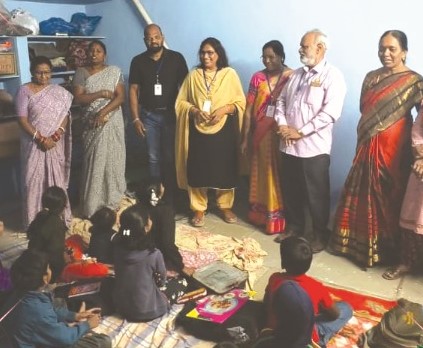
"Community Learning Centres bring education directly to the doorsteps of the most underserved communities." — Interventions, smilewithshinewelfaresociety.org
Most schools expect the child to make the journey. They expect a uniform, a bus fare, a parent free at the right hour, and a road that is safe to walk down. For a lot of the children we work with, that journey ends before it starts. So Smile With Shine Welfare Society flips it. The school comes to the child. This blog is a walkthrough of one of our Community Learning Centres (CLCs) — what it looks like, how it works, and why “doorstep” is the single most important word in the whole idea.
The Setup — A Room That Doesn't Look Like a School
A Community Learning Centre is almost always a borrowed corner of someone’s neighbourhood. A small verandah. A spare community room. A covered space behind a temple or a community hall. There are no rows of desks. There is no bell. There is no head teacher’s office down a corridor.
What there is, instead, is the following:
- A woven mat or a few low benches on the floor.
- A portable chalkboard or a small whiteboard propped on a wall.
- A stack of notebooks and slates.
- A small tray of snacks for the start of class.
- A teacher who lives in or near the same community.
That is a Community Learning Centre. Five things and a doorway. From our Interventions page:
"Smile With Shine Welfare Society's Community Learning Centres (CLCs) bring education directly to the doorsteps of the most underserved communities, operating in slums, tribal settlements, migrant colonies, and remote villages."
Why “Doorstep” Is the Whole Point
The geography of a child’s education in India is brutal. The nearest school may be three kilometres away. The bus may not run reliably. The fare may eat into the family’s daily wage. The route may pass through places a small child shouldn’t walk alone. The parent who would otherwise drop the child off may already be at a construction site by 7 a.m.
Every single one of those reasons is a distance reason. Not a money reason. Not an interest reason. Not a capability reason. Distance.
A doorstep classroom collapses all of that into nothing. The child walks ten metres, sits down, and starts. Their mother knows exactly where they are. Their father doesn’t have to pay a bus fare. Their grandmother can check in halfway through class. The whole apparatus of “getting to school” — the apparatus that quietly defeats most poor families — is just… deleted.
A Session, Start to Finish
5:30 p.m. — Setup
The teacher unrolls the mat. The notebooks come out of a cloth bag. The chalkboard is propped against the wall. The snack tray is laid out. If it’s a hot evening, a jug of water is filled from a neighbour’s tap.
5:45 p.m. — Arrival
Children begin to arrive. Some come straight from helping at home. Some come from playing on the lane. None of them are in uniform. They sit on the mat. The youngest take the front row. The older ones sit at the back, already opening their notebooks.
5:50 p.m. — The Snack
Before any lesson begins, the snack tray goes around. Biscuit, a banana, a small samosa — whichever is available that week. This isn’t a side detail. From our Monthly Programmes page, Drive 02 — Child Learning Centre Support lists snacks at ₹30 per child per session for a reason: a hungry child can’t learn long division.
6:00 p.m. — Lesson
The teacher splits the class softly. The youngest are doing alphabets. The middle group is doing two-digit addition. The eldest are doing comprehension from a hand-photocopied passage. The teacher moves between them. A child reads aloud. A child writes on a slate. A child gets the answer wrong, gets it wrong again, then gets it right and the whole row claps once.
7:00 p.m. — Homework Help
For children who are still enrolled in a regular school, this is the only part of their day when an adult sits down with their school homework. A maths problem they couldn’t do gets unstuck. A spelling list gets practised. A diagram for tomorrow’s science class gets copied.
7:30 p.m. — Sendoff
Notebooks go back in the cloth bag. The chalkboard comes off the wall. Children walk home in small groups in the direction they came from. Some of them are already arguing about a sum they got wrong.
The Teacher — The Person the Whole Thing Sits On
A CLC depends on a single human being more than anything else: the teacher who shows up at 5:30 p.m. on a school night, knows every child by name, and decides whether tonight is the night a kid finally cracks long division.
That teacher isn’t a volunteer. They’re paid — on purpose. Volunteer-led tuitions are unreliable; volunteers come and go. A paid teacher is consistent, accountable, and treated like the professional they are. From the same Drive 02 listing, the honorarium for one CLC teacher is published openly: ₹5,000 per month. That is the entire pay structure of the role we are trying to fund.
The Cost of the Whole Thing
Inside a single CLC, the money map is genuinely small. From the Monthly Programmes page:
| What You Fund | Cost | What It Covers |
|---|---|---|
| Snacks per child | ₹30 | One child fed at the start of one evening session. |
| Teacher honorarium | ₹5,000 | A month of evening teaching by one CLC teacher. |
Two line items. Both small. Both decisive. Together they keep a doorstep classroom open for a whole month.
What It Means for the Children
For the children at a CLC, the doorstep classroom is the first place that’s ever explicitly said: you are worth teaching, you are worth feeding before the lesson, you are worth waiting for if you’re late, and you are worth coming back to tomorrow. Most of them have never been told any of those things in a formal classroom.
That is what doorstep education actually delivers. It isn’t just convenience. It is a small, repeatable, two-hour signal — sent every evening, on a mat, on their own lane — that says: education is for you too.
How to Support a Community Learning Centre
Step 1 — Pick what you want to fund
- ₹30 — a snack for one child at one CLC session
- ₹5,000 — a month of honorarium for one CLC teacher
- ₹5,000 × 12 — a full year of one CLC teacher’s pay — the cleanest "I funded a centre" donation on the site
Step 2 — Pay via UPI
GPay / PhonePe to +91 73960 96830 or +91 70937 37459.
Step 3 — Or visit the donate page
For full payment options — QR codes and bank details — visit the donate page.
Tax benefit
"Contributions of ₹500 and above will get a receipt, where you can claim income tax returns." — Donate page
The Bigger Picture
The reason “bring school to the doorstep” works is the same reason “build more schools” doesn’t reach everyone: distance is not a building problem, it’s a life problem. A bigger school three villages over still doesn’t help the child whose mother can’t spare them in the morning. A doorstep classroom does.
That principle ties back to how Smile With Shine describes its work overall: serving humanity with Dignity, Equality & Compassion. A CLC is what that looks like when the subject is a child and the verb is “learn”.
Frequently Asked Questions
A small, simple room — sometimes a verandah, sometimes a borrowed community space — set up inside the neighbourhood the children live in. A mat on the floor, a chalkboard or portable whiteboard, a stack of notebooks, a snack tray, and a teacher who knows every child by name.
Roughly two hours, usually in the evening after the children’s other obligations of the day — chores, helping at home, informal work — are done. Short enough to hold attention, long enough to make real progress.
Distance is one of the biggest reasons underprivileged children don’t attend school — cost, time, safety on the route, and lost wages all stack on top of bus fares. A CLC removes the distance problem entirely: the classroom comes to the child, not the other way around.
Two line items, both published on the Monthly Programmes page: ₹30 covers snacks for one child for one session, and ₹5,000 covers a month’s honorarium for one CLC teacher.
GPay or PhonePe to +91 73960 96830 (or +91 70937 37459), or visit the donate page for full payment options. Contributions of ₹500 and above receive a tax-deductible receipt.
Keep a Doorstep Classroom Open
Pick a line item above. Send it. The thing your money names is the thing that happens.
Donate via UPI: GPay / PhonePe → +91 73960 96830
📍 Smile With Shine Welfare Society, Vivekananda Nagar, Mallapur, Nacharam, Secunderabad, Hyderabad — 500076
☎ +91 73960 96830 | +91 70937 37459
Explore More on Our Site
- What Is a Community Learning Centre and Why Does It Matter?
- Hunger Doesn't Take a Day Off — Lessons From a Weekly Meal Drive
- Donate for Child Education in India: Where Your Money Actually Goes
- All 12 Interventions
- Monthly Programmes
- Donate